
Trail notes
- The Cleveland Lakefront Nature Preserve is 88 acres with three trails totaling 2.5 miles, according to the Port of Cleveland.
- Researchers and visitors have identified 280 species of birds and 42 species of butterflies at the preserve.
- The preserve is open to the public during daylight hours and is entered behind the Cleveland Metroparks Lakefront Office at 8701 Lakeshore Blvd. NE.
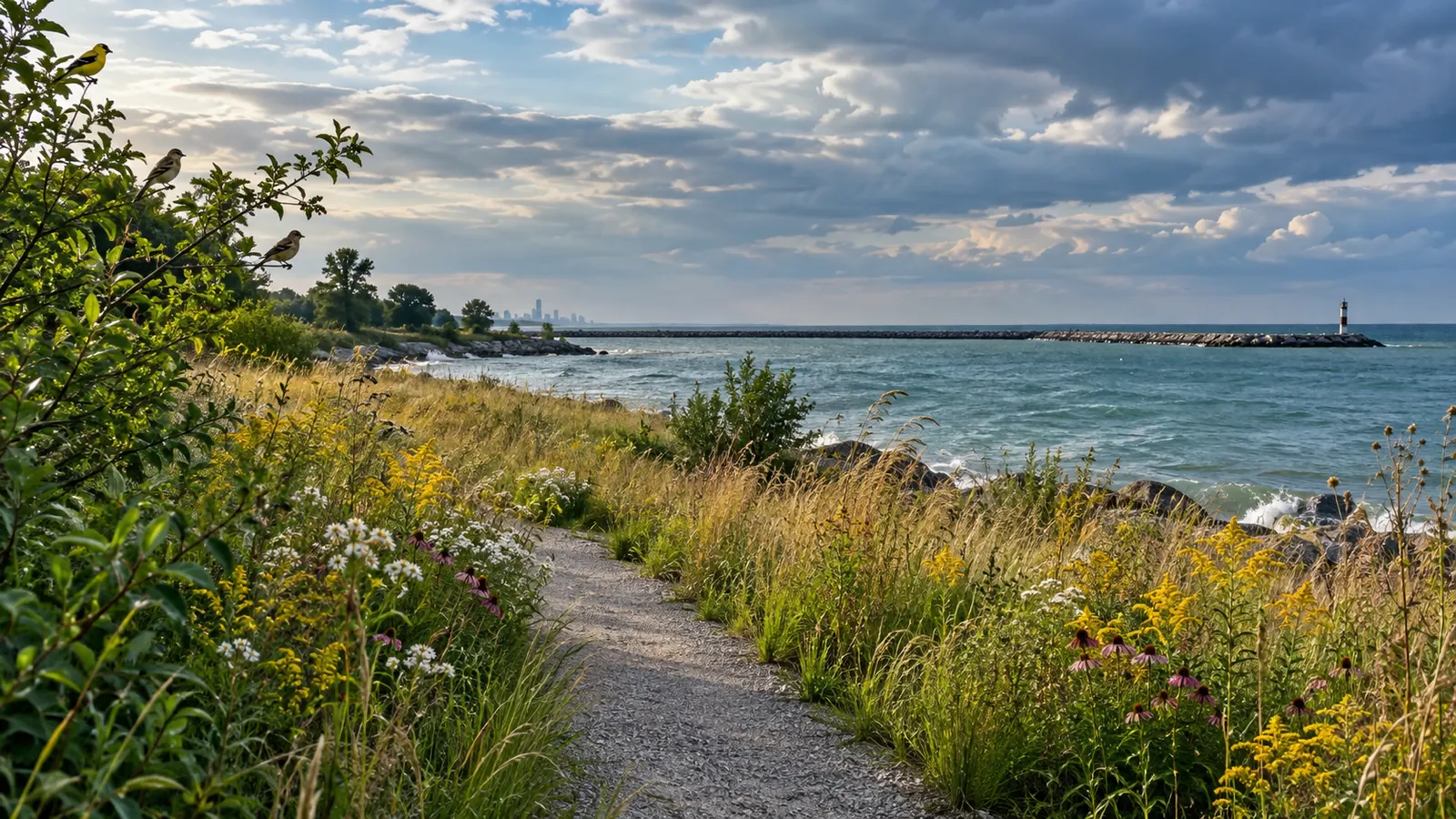
Some of the best nature in Cleveland, Ohio, grew on land that did not exist 50 years ago. The Cleveland Lakefront Nature Preserve is a peninsula on the east side of the city, built from sediment dredged out of the Cuyahoga River and then left largely alone. Today it is a free, quiet place of meadows, thickets and shoreline, with wide views of Lake Erie and the downtown skyline. It is run by the Port of Cleveland.
From dumping ground to preserve
The preserve’s story, as the Port tells it, starts with a gift. In 1896 William Gordon willed the original shoreline here to the City of Cleveland for a public park, now Gordon Park. In 1962 two old freighters were sunk offshore to make a breakwall protecting the park’s beach. In that era, dumping solid waste along the lakeshore was not unusual, and waste filled an area of about 10 acres between the sunken ships and the shore.
The landmass itself took shape from the late 1970s. The U.S. Army Corps of Engineers placed sediment dredged from the Cuyahoga River inside a walled confined disposal facility called Dike 14, from 1979 to 1999. Layers of sand, soil and clay built up. After the Corps stopped using the site, nature took over with very little human help, and plants, trees and shrubs drew birds and other wildlife. Dike 14 is now known as the Cleveland Lakefront Nature Preserve.
What you will find
The Port describes 88 acres with three trails totaling 2.5 miles. The habitats are unusually mixed for a city park: grasslands, a forest area, meadows, mudflats, shrublands and wetlands. Over time, researchers and visitors have identified:
| Group | Species recorded |
|---|---|
| Birds | 280 |
| Butterflies | 42 |
| Ohio plants, including wildflowers and grasses | 26 |
| Mammals | 16 |
| Trees and shrubs | 9 |
| Reptiles | 2 |
Those counts come from the Port’s own page. With 280 bird species on the list, birding is the main draw, and a peninsula sticking out into Lake Erie is the kind of place where migrating birds stop to rest.
Hours and how to get in
The preserve is open to the public during daylight hours; the Port’s field guide describes it as open from daylight to dusk, year-round. There is no fee. The entrance is a little hidden. The Port’s directions: the preserve is directly behind the Cleveland Metroparks Lakefront Office at 8701 Lakeshore Blvd. NE, Cleveland, OH 44108. Driving north on Dr. Martin Luther King Jr. Boulevard, follow the road to the right as it becomes Lakeshore Boulevard heading east, then take the first left into the Metroparks parking lot. Walk around the west side of the office to the preserve entrance.
Tip: Download the Port’s free field guide before you go. It has illustrations, history and natural history notes, and it makes a walk much more interesting if you are trying to tell one sparrow or aster from another.
When to go
Spring and fall migration
Lake Erie’s shoreline is a resting point for birds crossing the lake, so spring and fall are the seasons birders watch. Mornings are usually best, when small songbirds are most active in the thickets.
Summer
Meadows fill with wildflowers and butterflies. There is little shade on much of the trail system, so go early or late on hot days and bring water.
Winter
The preserve stays open year-round. Wind off the lake can make it feel much colder than downtown, but clear winter days bring the sharpest skyline views.
Making the most of a visit
- Bring binoculars; many birds stay deep in the shrubs.
- Walk slowly and stop often. A loop of all 2.5 miles takes longer than you would think if you are watching for wildlife.
- Stay on the trails to protect nesting birds and plants.
- Pack out everything you bring in.
- Check the forecast. The peninsula is exposed, and weather on the lake changes quickly.
Combine it with the shoreline
The preserve is on the east side of the city’s lakefront, and a visit pairs well with a walk along the shore or an afternoon at a beach. Before swimming anywhere on Lake Erie, it is worth understanding how water quality is reported and what the warning signs mean; see Lake Erie Beach Water Quality: How to Read Cleveland’s Swim Advisories and Lake Erie Swimming Safety: Waves, Pier Currents and Rip Currents.
Why it matters
The Port describes the preserve as both a respite for wildlife and a way to give the community access to lakefront trails. For a city whose shoreline was long given over to industry and highways, an 88-acre wild space made from river mud is a striking turnaround, and one that costs nothing to enjoy.