
Trail notes
- The National Park Service describes Brandywine Falls as a 60-foot waterfall reached by a partially accessible boardwalk; another NPS page lists it at 65 feet.
- The Brandywine Gorge Loop is 1.5 miles with a 160-foot elevation change.
- Brandywine Falls is open daily from dawn to dusk, and the boardwalk may close in icy conditions.
Northeast Ohio is not mountain country, yet the creeks that drop into the Cuyahoga River have carved some striking waterfalls into the valley walls. The best known is Brandywine Falls in Cuyahoga Valley National Park, a short drive south of Cleveland. Seeing it costs nothing, and the boardwalk view takes only a few minutes. Getting a parking space is the hard part.
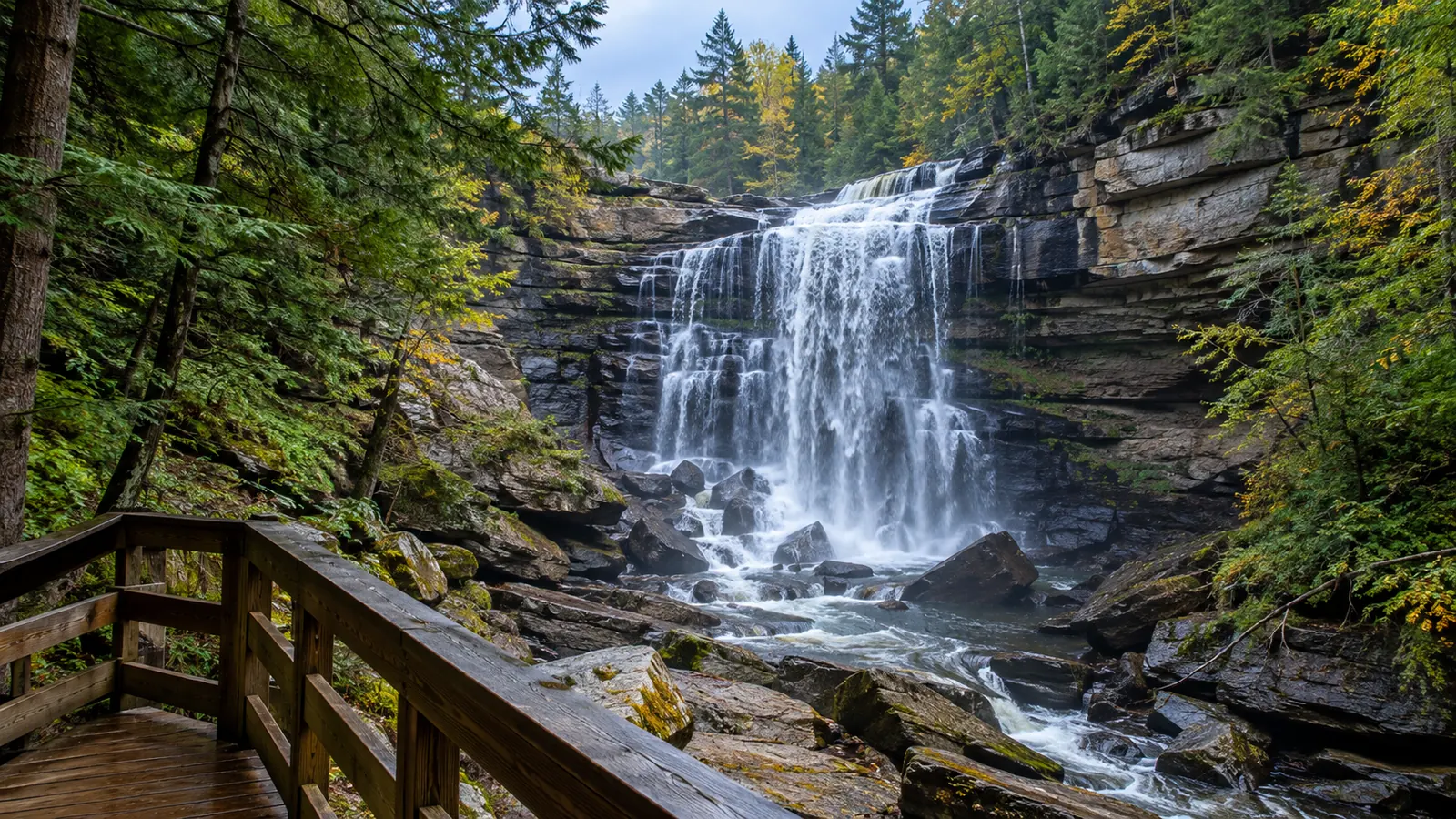
Brandywine Falls at a glance
| Detail | What the park says |
|---|---|
| Height | 60 feet on the park’s main falls page; 65 feet on some other NPS pages |
| Hours | Daily, dawn to dusk |
| Address | 8176 Brandywine Road, Sagamore Hills Township |
| Access | Boardwalk from the parking lot; partially accessible |
| Entry | Free, like the rest of the park |
| Busiest times | Nice weather and summer, roughly mid-morning to mid-afternoon |
The National Park Service calls Brandywine Falls among the most popular attractions in the park. Its half-day visit guide also describes it as the second highest falls in Ohio.
Seeing the falls from the boardwalk
A boardwalk leads from the parking area to upper and lower observation platforms that face the falls head on. The park says a boardwalk route without stairs is available, and wheelchair users can follow a short path from the lot to the upper viewing area. For the closer, lower view, the park’s trail description says to walk down approximately 80 steps to a lower viewing deck.
In icy weather the boardwalk may be closed, so a winter visit should be planned around conditions. The park’s current conditions page is the place to check.
Hiking the Brandywine Gorge Loop
If you have an extra hour, the park recommends the Brandywine Gorge Loop. It is a 1.5-mile hike with a 160-foot elevation change, best done early or late in the day to avoid crowds. The clockwise loop drops into the gorge, crosses a footbridge above the creek and climbs back up the other side, passing the historic house that is now the Inn at Brandywine Falls.
- Wear sturdy shoes; the trail is hilly and rocky in places.
- Keep bearing right at trail intersections on the clockwise loop, as the park’s directions suggest.
- Stay on marked trails to protect the fragile gorge habitat.
- The park recommends the hike for ages 6 and older.
- Leashed dogs are allowed on trails; leashes must be 6 feet or less.
The trail is not wheelchair accessible. In spring, the park suggests looking for vernal pools along the way, which temporarily fill with water and attract breeding salamanders.
How to actually find parking
The park is direct about this: during nice weather and throughout summer, the Brandywine Falls lot is generally full in the middle of the day. There is no overflow parking, and the lot also serves the Bike & Hike Trail run by Summit Metro Parks. Do not park on the roadway; the park warns that vehicles have been damaged, ticketed and towed.
Arriving early or late is the simplest fix. Another option is to hike in. The park suggests starting from Boston Mill Visitor Center, Boston Trailhead or Stanford Trailhead and connecting to the gorge loop by the Stanford Trail. From Boston Mill Visitor Center, the park puts the round trip at about 5.7 miles with a cumulative 440-foot elevation change. From Stanford Trailhead it is about 4 miles round trip.
Tip: Bring water if you hike in from Boston. The park notes drinking water at Brandywine Falls Trailhead is only available seasonally.
Why the falls look the way they do
Brandywine Creek carved the falls, and the park explains them as a textbook waterfall. A hard cap of Berea Sandstone sits on top and protects softer layers underneath: the Bedford and Cleveland shales, formed from mud on a sea floor 350 to 400 million years ago. Shale breaks in thin chunks, which gives the water its bridal-veil look as it spills down. From the boardwalk you can see individual sand grains in the Berea Sandstone, a stone that was also widely used in local buildings and canal locks.
The gorge stays moist, so moss grows on the rock and eastern hemlocks line the slopes. In fall the hemlocks contrast with red maples, which the park says flame with color. With less water in late summer the veil pattern becomes more pronounced, and in winter ice becomes the attraction.
A village that was here first
Early settlers valued the falls for water power. The park records that George Wallace built a sawmill at the top in 1814, followed by grist and woolen mills, and a village called Brandywine grew around them. Much of it disappeared with the construction of Interstate 271. The James Wallace house, built by George’s son, survives as the bed and breakfast beside the trail.
A quieter option: Blue Hen Falls
For fewer people and more hiking, the park points to Blue Hen Falls, a 15-foot waterfall reached by the Buckeye Trail from Boston Mill Visitor Center. The park describes the route as steep, rocky and often muddy, with an unmarked road crossing and a steep hill down to the falls. The area is still busy in the middle of nice days, so the same early-or-late advice applies.
Waterfall safety
Wet rock near falling water is slippery in every season. Stay on boardwalks and marked trails, keep children close at overlooks, and skip the boardwalk when it is closed for ice. Spring and the hours after heavy storms are when the falls carry the most water; the park notes that runoff from paved surfaces upstream has increased flow compared with historic levels.
For the rest of a falls day, the Towpath and the Ledges are close by; see Cuyahoga Valley National Park for Beginners: A Free Day Next to Cleveland for a simple plan, or Winter in Cuyahoga Valley: Sledding, Snowshoeing and Icy Ledges for Free if you want to see the falls in ice.