
Trail notes
- The West Side Market opened to shoppers on November 2, 1912, and calls itself Cleveland’s oldest continuously operating municipally owned market.
- Regular hours are Monday, Wednesday and Friday 8 a.m. to 5 p.m., Saturday 8 a.m. to 5 p.m. and Sunday 10 a.m. to 4 p.m.
- Parking in the market lots is free for the first 90 minutes during market hours.
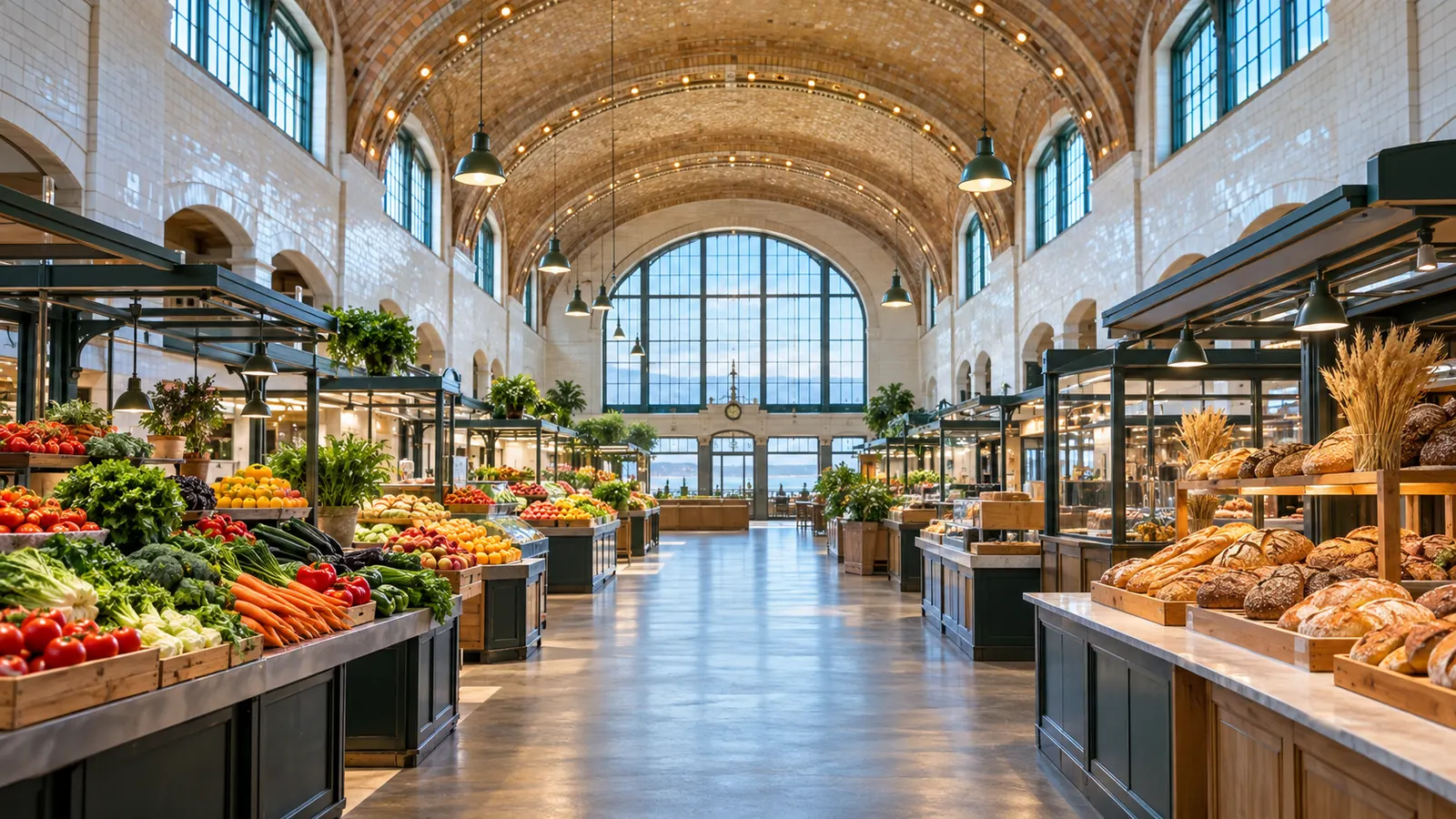
You do not have to buy anything to enjoy the West Side Market. Step inside the main hall in Cleveland, Ohio’s Ohio City neighborhood and look up: a tiled vault soars over rows of stands selling meat, cheese, bread, pastries and spices, and the noise of a busy Saturday echoes off the ceiling. For more than a century the market has been a place to shop, but it is also one of the city’s great free sights.
When to go
| Day | Hours |
|---|---|
| Monday | 8 a.m. to 5 p.m. |
| Tuesday | Closed |
| Wednesday | 8 a.m. to 5 p.m. |
| Thursday | Closed |
| Friday | 8 a.m. to 5 p.m. |
| Saturday | 8 a.m. to 5 p.m. |
| Sunday | 10 a.m. to 4 p.m. |
Those are the market’s regular hours; holiday openings are announced on its website, and the phone number is (216) 293-9830. Saturdays are the liveliest. Weekday mornings are calmer if you want space to look around and talk with vendors.
Parking without paying
The market’s own lots are behind the building. They switched to a gateless system in 2024: you drive in, park and pay by scanning a code on the signs, texting a posted number or using a credit card kiosk by the produce arcade doors. The key detail for a free visit is that parking is free for the first 90 minutes during market hours. After 6 p.m. there is a flat evening rate of $6, and special events outside market hours carry a $10 flat rate.
Tip: The market warns that official parking attendants wear red vests, and that no attendant or market employee will approach your car asking for cash or a donation. Anyone who does is not with the market.
The building is the show
The market’s history page is full of numbers worth knowing as you walk in. The hall measures 241 by 124 feet, with a 44-foot-high Guastavino tile vaulted ceiling, and its clock tower stands 137 feet tall. It was championed by Mayor Tom L. Johnson and designed by local architects W. Dominick Benes and Benjamin Hubbell. Construction began in 1908, the cornerstone was laid in 1910, and Mayor Newton D. Baker dedicated the market on October 31, 1912. It cost $734,890.72 to build.
The market replaced the Pearl Street Market, which had stood on the opposite corner since 1840. In the early 20th century it was one of three public markets serving Cleveland’s growing immigrant population, alongside the Broadway Market and the Central Market. Only the West Side Market remains.
Then and now
- 1912: 109 stands inside sold meats, dairy, bread, groceries and specialty foods. Produce was sold from curb stands until outdoor produce aisles were built a few years later.
- 2008: the American Planning Association named it one of 10 Great Public Places in America.
- 2012: the market celebrated its centennial; historic images were hung above the stands.
- Today: the market says it is home to more than 60 vendors, and a large renovation of the landmark is underway.
Take the free history tour
The market has a self-guided historical tour built around QR codes and printed panels at six locations inside the building, including audio pieces on the architecture and the neighborhood. Scan the codes with your phone as you go. If you need printed transcripts or the audio guide, the market says to stop at the information booth in the produce arcade.
A cheap market morning
A good plan for a low-cost visit is to set a budget before you walk in. Browse the full hall first without buying, then come back for one or two things: a pastry, a piece of cheese or fruit from the produce arcade. Eat it outside or carry it to a nearby park bench. Bring cash and a reusable bag; you will move faster at busy stands.
Around Ohio City
The market anchors the historic Ohio City neighborhood on the near west side. It is easy to combine with a walk through the surrounding streets. In Ohio City’s Hingetown neighborhood, the Cleveland Museum of Art runs Transformer Station, a space for emerging artists, time-based media and live music; see The Cleveland Museum of Art for Free: How to Plan a Visit for more on the museum’s free programs.
Getting there without a car
Ohio City sits on the near west side, close to downtown, and RTA buses and trains serve the area. Skipping the car means skipping the parking clock entirely. Fares and passes are explained in Cleveland Without a Car: RTA Fares, Passes and Free Rides for a Weekend.
Good manners at the stands
- Ask before taking close-up photos of a vendor’s stand.
- Step aside to look so others can reach the counter.
- Keep strollers and bags out of the narrow aisles on busy Saturdays.
- Do not touch food you are not buying.
The market describes itself as a third space where people from all walks of life can visit, shop and do business. Treat it like a neighbor’s kitchen, and it will feel that way.